Podcast: Play in new window | Download
In this episode, we learn how science itself has dramatically changed — and we coin a new word.
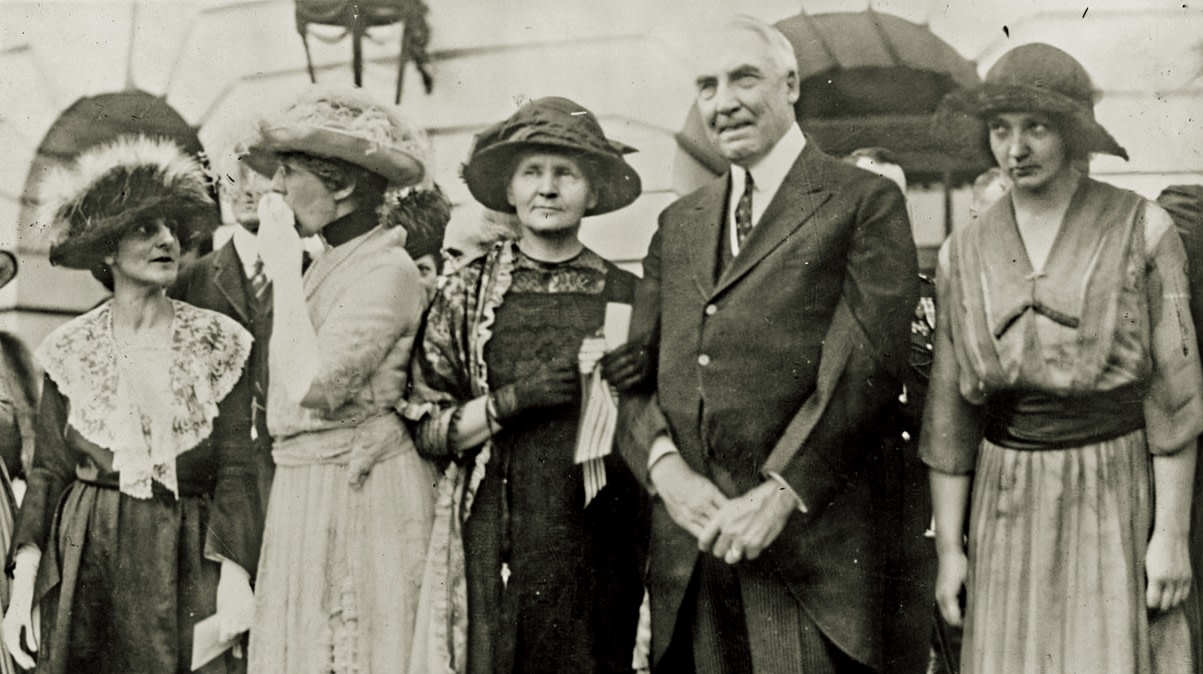
Featured above (L to R): Journalist Marie Meloney, First Lady Florence Harding, Marie Curie, President Warren G. Harding, and Irène Curie.
Show Notes
Well, hello, earlybird! Once again, I wanted to get the episode out ASAP, even though the show notes aren’t entirely ready yet. Check back later for more — but enjoy what’s ready for now, including that story about the RMS Olympic:
Credits: superhero fanfare by humanoide9000 — https://freesound.org/s/505426/ — License: Attribution 4.0
Kalimba (C-note) by foochie_foochie — https://freesound.org/s/331047/ — License: Creative Commons 0
With Apologies: The sound quality is definitely subpar in this episode. You’d think at this point I’d have a good workflow down to record quality VO, but, well, I don’t. At this point, I didn’t want anything else to delay the release of this episode!
I spent at least six weeks contemplating the spelling: In the script, I write “stoicheiophily”, but a decent case could be made in favor of “stoichiophily.” After all, “stoichiometry” is already a word we have for measuring quantities of reactants and products of chemical processes. However, more often than not, stoichiometry deals with compounds rather than pure elements. To put an emphasis on the collection of elemental substances, I went with the word root that hews closer to the Greek for “element.” However, I’m perfectly happy to say both are acceptable spellings of the word, if it gets one more person out there to mention it at a cocktail party.
Either way is right: Many sources say that curium was discovered before americium, making their chronological order the opposite of their atomic order. However, none of those sources were primary, so I didn’t feel confident including it in the episode. It seems quite plausible, though!1 2
Dubious Honor: One award I almost mentioned is the Carver-Curie Diversity Award, named after George Washington Carver (whom we discussed in our protactinium episode) and Marie Curie. “The achievements of these two world-class scientists epitomize the advantages that diversity and inclusion offer the chemical industry and the world.” How cool! Who have been the recipients of this esteemed prize? scrolls down … Apparently the only three winners have been BSAF, Dow, and ExxonMobil. Suddenly not nearly as cool. Besides, it doesn’t seem to have been awarded to anyone since 2020.
Icky! Perhaps some long-neglected neuron in the deep recesses of your mind lit up at mention of the RMS Olympic. If so, you may have heard that she was launched in 1910 by White Star Line… as the sister ship of the Titanic.
When the latter sank on its maiden voyage, the Olympic wound up in a rather awkward spot. The two ships were essentially identical — so who in their right mind would willingly board a second Titanic?
White Star knew they had to do something, so they rushed to fit the Olympic with dozens of additional lifeboats. That sounds like a good idea, but it was mostly a PR stunt. Workers took one look and found that these lifeboats, purchased secondhand, were rotten, full of holes, and otherwise unseaworthy. When a corporate manager insisted that they were fine and the crew should get back to work, hundreds of workers immediately halted work and refused to sail. 3 Before long, they were intoxicated en masse and singing on the docks.
The company quickly hired hundreds of non-union workers (scabs) to take their place — which caused dozens of sailors to join the strike in solidarity, rendering the ship unable to set sail. They were arrested for mutiny, and the charges proved, but there was such a groundswell of public support for the strikers that the judge declared it would be “inexpedient to send the men to prison or impose a fine.”4
It took several months, but White Star begrudgingly refit the ship in an adequate manner, adding dozens of (seaworthy) lifeboats and significantly reinforcing the hull.
That was worth something, because the Olympic would later collide with something much more aggressive than an iceberg.
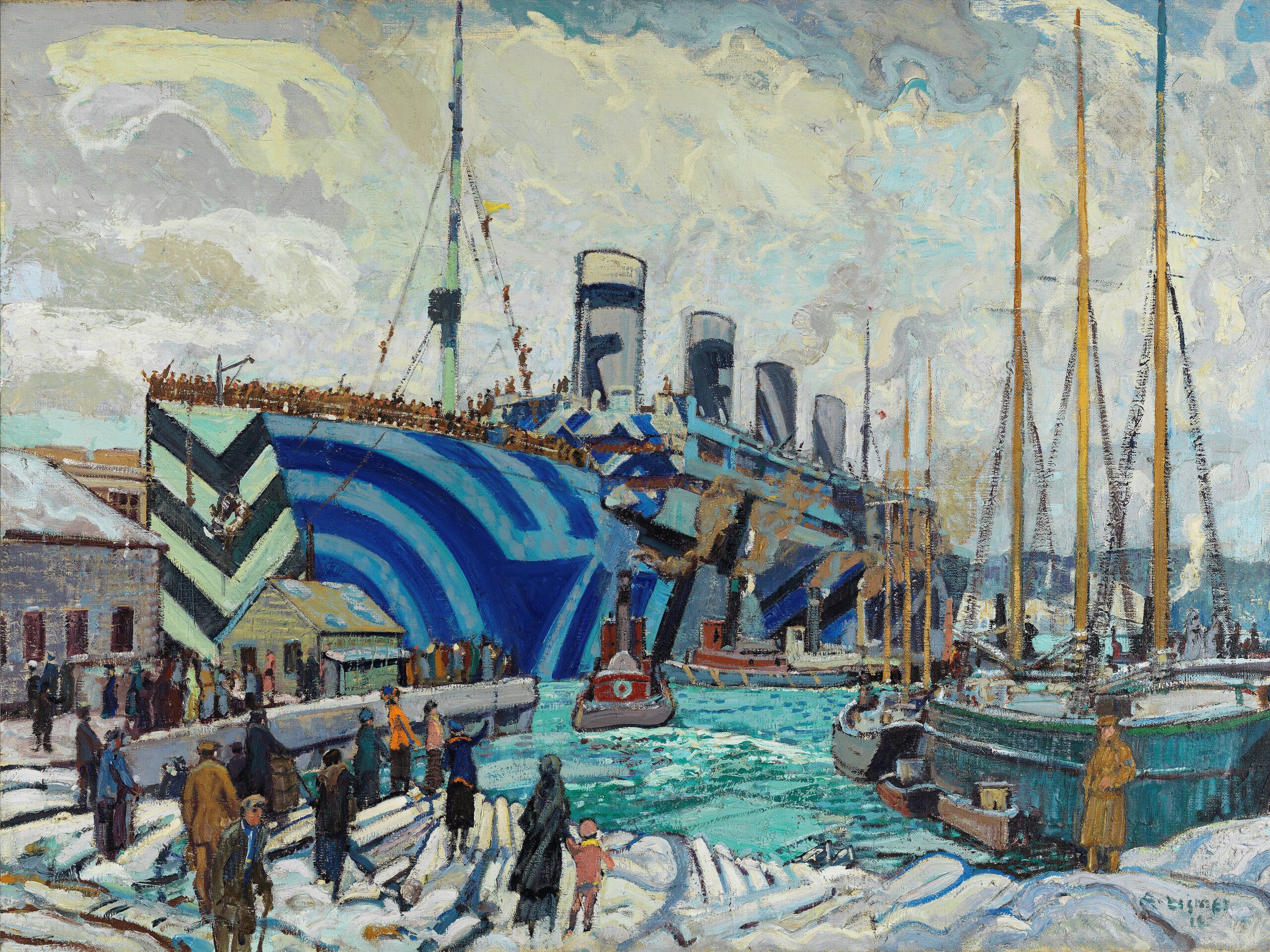
In 1915, two guns were mounted aboard, a twelve-pounder and a 4.7-inch, because she had been requisitioned by the Admiralty of Great Britain following the start of World War I. Now she became a transport ship, tasked with moving six thousand troops through waters patrolled by U-boats. Later, she was even painted with dazzle camouflage, a garish pattern of brown, blue, and white stripes at dizzying angles, meant to hamper enemies’ ability to estimate her movement.5
In 1918, while crossing the English channel, Captain Bertram Hayes sighted the German submarine U-103, with its torpedoes aimed squarely at them. Without hesitation, Hayes ordered, “Hard a-port!”and sped directly at the sub. Unaccustomed to a ship so large and fast, the U-boat captain panicked, failing to respond quickly enough. The passenger liner cut into the sub with all the force of a Honda Civic slamming into a large bag of potting soil.6 Except it was worse, because the U-boat was drawn under the ship by suction, where the propeller tore open the sub’s ballast tanks. The wreck of U-103 sank 49 fathoms below the English Channel, where it remains to this day. The Olympic suffered a few dings and dents, but its hull remained perfectly intact.7
The ship earned the nickname “Old Reliable,” and she certainly was. The Olympic returned to civilian service after the war, providing transatlantic passage for fifteen more years in a most fashionable style. Celebrities could often be found on board, including Charlie Chaplin, Mary Pickford, Arthur Conan Doyle8… and, as I was trying to say before I was so rudely interrupted, Marie Curie.
Episode Script
When Glenn T. Seaborg and crew discovered element 96, they named it in honor of Pierre and Marie Curie. They gave it the symbol “Cm” — partly because it was one of the few options left, considering C, Cu, and Cr were already taken, but they also explained that the “m” was specifically meant for “Marie.”
That turned out to be rather ironic, because Marie almost certainly would have despised what Seaborg went on to do with the element that carried her name.
You’re listening to The Episodic Table Of Elements, and I’m T. R. Appleton. Each episode, we take a look at the fascinating true stories behind one element on the periodic table.
Today, we’re claiming intellectual property about curium.
Admittedly, Madame Curie had some strong opinions, and she very well may have had a low opinion of us, as well. “Be less curious about people,” she was known to say, “and more curious about ideas.” For the record, this is the fourth episode in which we’re substantially talking about the Curies for being just so darn fascinating.
Scientific achievement brought some measure of fame, but no great fortune, to the Curie house — Marie and Pierre were basically uninterested in both, devoted to research alone. They believed that commercial success was essentially contrary to scientific progress, especially when such work could help fight diseases like cancer. Together, they decided the elements they discovered should be free.
A noble and high-minded sentiment to hold. Still, one can’t help but wonder if some degree of prosperity might have been beneficial for their cutting-edge research.
Because there was a problem here: open-sourcing their discoveries did nothing to make the actual material any more accessible. Radium quickly became a hot commodity, but one that was scarce and difficult to extract. It required scads of money and specialized industry to produce, making it more available to corporations seeking profits than to scientists seeking knowledge.
To extend the metaphor: Linux might be free software,9 but you still need a computer to install it on.
For their part, the Curies did not work in some slick, state-of-the-art laboratory. They made their most famous discoveries by boiling vats of pitchblende in huge iron cauldrons inside a drafty wooden shed. For four years, they choked back lungfuls of foul gas, refining ore twenty kilograms at a time. They ended each day “broken with fatigue,” in Marie’s own words, and the threat of poverty hung constantly over their heads. 10 11 12 13
Such a lifestyle is not much improved by making professional necessities prohibitively expensive. By 1920, Pierre Curie had passed away, but Marie was still living a shockingly humble life — a fact that became especially apparent when she sat down for a rare interview with an American journalist, Marie Brown Meloney. Curie didn’t know it at the time, but Meloney was about to change all of that.
Meloney wrote for a magazine called The Delineator, and her work was marked by a strong sense of justice and righteousness. She advanced causes from public health and housing to postwar humanitarian relief and women’s rights.14
All those concerns collided in the story she wrote for The Delineator’s April 1921 issue. Upon arriving at the Institut Curie, Meloney was immediately struck by the austerity — especially incongruous with its beautifully baroque Parisian surroundings.
The reception-room … was almost as bare as a nun’s cell. There were seven stiff wooden chairs and a plain oblong table. On the walls there were two maps, one of Paris, one of France, and the plainest clock I ever saw in France.
It was a cold, bare room, stripped of all human frivolity and pretense. … If I had found her in one of the marble palaces on the Champs-Élysées, I should have felt more comfortable about it.”15
Meloney was so shocked because she thought patent royalties would’ve made Curie a wealthy woman.
That might sound a little confusing, because, as we learned all the way back in episode three, elements generally cannot be patented, because “products of nature” are discovered rather than invented.
However, the process by which the Curies extracted and isolated radium — all that business with the bubbling cauldrons — there is no question they could have patented that. If they had, then they would’ve received proceeds from all those radium products– and there were a lot at the time. The glow-in-the-dark watches, gamma-ray lipstick, all the radiumiferous health elixirs, those all could have put money in the Curies’ pockets — but they chose against that.
Considering how many people were hurt or killed by those radium products, it’s hard to say they made the wrong decision.
Nonetheless, plenty of people with fewer scruples did make their fortunes off of radium — vast fortunes. And Marie Meloney made conspicuous note of them, men who “count their wealth in millions,” and “have cars and servants and palatial homes.”
With business booming, radium became a costly commodity — so expensive, that Curie herself could no longer finance all the work she wished to do. She continued teaching, writing, and building bridges in the scientific community, but exploratory lab work suffered for lack of materials. Meloney believed this was inexcusable. She wrote, “…Madame Curie, who, after long, hard years of struggle against resistant nature wrested from the earth the secret of radium, is too poor to purchase the precious stuff for further and much-needed experiments.”16
This was not mere bluster on the author’s part. Privately, she made a sworn promise to Curie. She later wrote:
‘You ought to have everything in the world you need to go on with your work,’ I said. “Some one must undertake this.’
‘Who will?’ she asked rather hopelessly.
‘The women of America,’ I promised — and then I rose to go.”17
Meloney soon learned that a single gram of radium would cost one hundred thousand dollars — nearly two million in 2026 money18 — but she did not falter.
First, she sought high-value prospects: ten wealthy women who could supply ten thousand dollars each, neatly and quickly enabling the purchase of element 88. Sadly, the Park Avenue crowd was unwilling to chip in, but she was undeterred. “There were not ten to buy that gramme of radium,” she wrote, “but there were a hundred thousand women…”
*This* campaign was *very* successful. A spirit of muliebrious possibility persisted following the passage of the 19th Amendment less than a year earlier, which granted (some) women the right to vote.19 From coast to coast, women and girls went door-to-door, accepting every last penny they could solicit. They were a strong force: Within a year, the Marie Curie Radium Fund had surpassed its revenue goal by over fifty percent.
Pittsburgh’s Standard Chemical Company produced the sample — precisely one gram of radium — and it was Marie’s to take with but a single string attached: The Marie Curie Radium Fund Committee asked her to come and get it.
The invitation was made with good intentions. The donors simply wanted to express their good will toward the recipient. But it was actually a monumental ask. Decades of unprotected exposure to ionizing radiation had taken a severe toll on Curie’s health, and she also had cataracts and complications from kidney disease.
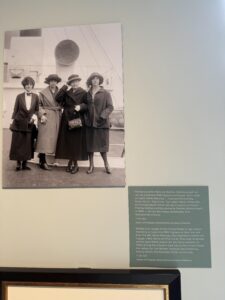
Of course, none of that would actually keep Madame Curie from her radium. In the spring of 1921, at 53 years of age, she clambered aboard the RMS Olympic to make her first transatlantic voyage.20
She was met in New York Harbor by throngs of adoring fans and dozens of photographers. Alongside her daughters and Meloney, Curie was welcomed at the White House, where President Warren G. Harding presented her with a lead-lined mahogany box designed to hold the gram of radium; a golden key to unlock the case; and a scroll tied shut with a red, white, and blue ribbon — the deed of ownership. A plaque on the box read, “Presented by the President of the United States on behalf of the women of America to Madame Marie Skłodowska Curie in recognition of her transcendent service to science and to humanity in the discovery of radium.”
A lovely afternoon, to be sure, but that was just the beginning of a whistle-stop tour that lasted more than six weeks. She visited fifteen different universities, giving speeches, touring laboratories, receiving honorary doctorates, and attending luncheons from New England to Colorado.
It was the trip of a lifetime, especially for Ève and Irène, who were treated like glamorous celebrities by the press. But it was also a great deal of work for the already-exhausted Marie. Reporters noticed this, with one newspaper publishing an article with the headline, “Too Much Hospitality”. In part, that read, “The American women showed fine intelligence when they came to the aid of the scientist, but bitter critics might well say that we had made Mme Curie pay with her own flesh for our gift, for the mere satisfaction of our pride. … any circus or variety manager would have offered Mme Curie much more money for half as much work.”21
It wasn’t all bad, though. Curie took authentic interest in the labs and scientists she visited, and appreciated the sights she got to see. At the end of her trip, she said, “I especially appreciate the opportunity of seeing two of the great natural wonders of America: the Grand Canyon, which, despite the heat, was a rare pleasure, and Niagara Falls with its matchless beauty.”22
The voyage created a special bond between Curie and the American public. As a farewell, she said, “I feel that I have three countries — the land of my birth, the land of my adoption, and the land of my new friends.”
That trip, along with another in 1929, and her death in 1934, would have been relatively recent history when Seaborg and crew first synthesized elements 95 and 96. In need of a suitable person as namesake for the latter, the Curies would easily have been top of mind.
However, the discovery of curium bore little resemblance to anything the Curies had ever done — or any other chemist, for that matter.
Glenn Seaborg, Ralph James, and Albert Ghiorso worked out of the University of California – Berkeley lab, where they operated the *cyclotron*, a room-sized particle accelerator capable of performing nuclear alchemy. With this device, they shot alpha particles at 13% the speed of light toward a sample of plutonium, itself only recently discovered by the same team. This irradiated material was then sent to the University of Chicago’s Metallurgical Laboratory, an industrial-grade facility at an academic institution, where the work continued with a supergroup of scientists, including Episodic Table alums like Enrico Fermi, James Franck, and Luis Alvarez. And lest we forget, all this work was being done during the most colossal mobilization of resources in history.
A far cry from a drafty shed and four hands.
But perhaps the most significant difference between this group and the Curies was the *money*. Whereas Pierre and Marie had to scrimp and save, a seemingly bottomless coffer backed this science. The Manhattan Project had a total budget over two billion dollars, which is more than forty billion in 2026 dollars.23 24 And the scientists in charge earned their fair share of that money — the equivalent of a quarter to half a million dollars per year today.25
Marie and Pierre grew callused palms and crooked backs through their toil. Of the scientists behind the atomic bomb, one contemporary described them as “salesman types,” “Madison Avenue-type scientists,” and “Scientists in gray flannel suits.” 26
Acting in full accordance with such a characterization, Glenn Seaborg did something the Curies never would’ve dared: he filed for patents on elements 95 and 96. Not just the *processes used to isolate* those elements — patents on the very elements themselves.27 28 And sure enough, on U.S. Patent three, one five six, five two three, “Element 95 And Method Of Producing Said Element,” and on U.S. Patent three, one six one, four six two, “Element 96 And Compositions Thereof”, only one name appears: Glenn T. Seaborg… “inventor”.
What audacity! What avarice! Are these atoms not “products of nature?” And how dare he take singular credit for an element wrought by the efforts of dozens of scientists! It’s hard to imagine a greater betrayal of the scientific ideals embodied by the very people for whom this element was named.
Except… well… there may have been a *little* nuance to the situation.
Don’t get me wrong — this was a *brazen* legal maneuver, but it was not for Seaborg’s personal profit. By his own account, he was “just a name” that got slapped on the paperwork, little more than a necessary formality.29
You see, this was all happening amidst the onset of a historical paranoia: The end of World War II, the dawn of the Cold War. And these scientists were finding materials unlike anything ever seen before — materials with apocalyptic potential. The government wasn’t exactly sure what this “curium” stuff might be capable of, but for safety’s sake, they wanted to keep it out of the wrong hands, by any means necessary.
In this case, that meant Seaborg, at the behest of the Atomic Energy Commission, had to file with the Patent & Trademark Office. Now, the PTO rejected the claim at first, but not because curium and americium counted as “products of nature.” Since elements heavier than plutonium really can’t be found in nature, they were considered human artifice, and thus patent-eligible.
The problem, according to the Patent Office, was one called *inherency*. They determined that this application was invalid, because americium and curium would have already been created as byproducts of Enrico Fermi’s nuclear reactor — an invention that was already covered by patent two, seven zero eight, six five six. To use the legal jargon, that made curium “prior art”. 3031
Fermi and his team didn’t even realize their reactor produced curium and americium, let alone mention them in the patent. The amounts created were beyond minuscule. It would be more accurate to call them “theoretical.” But it was enough for the Patent Office, who rejected Seaborg’s application on those grounds.
Well, the AEC wasn’t going to take that sitting down. They filed an appeal. Thus arose the slightly awkward situation of the U.S. Government fighting the U.S. Government. And contrary to Seaborg’s claim that he was “just a name” on the paperwork, his involvement was indispensable to this battle. It was *his name* on the patent. The AEC might have been able to proceed without his cooperation, but the entire case would’ve been significantly more precarious.
That put Seaborg in an enormously powerful position, but he didn’t really act like it. He actually preemptively assigned all ownership rights — and thus, any potential profit from americium and curium — over to the U.S. Government in exchange for a single dollar.
Why might he do such a thing? It’s hard to say for certain. Seaborg’s own words make it sound like he believed government ownership of nuclear materials was something between “appropriate” and “inevitable.”32
He was famously non-confrontational in political matters, despite working in a highly political field. Perhaps he took note of how principled opposition was treated — you might have heard, there’s an entire feature film about how poorly the Atomic Energy Commission treated J. Robert Oppenheimer.33
I mentioned that the americium and curium created by Fermi’s reactor were “minuscule” amounts — if you do the math, there might have been a single nanogram of americium, and a picogram of curium, spread out among forty tons of nuclear waste.34 Seaborg’s legal team pointed out that these materials were never mentioned in Fermi’s 1944 patent application for his “neutronic reactor”, and argued that they couldn’t have even been detected at the time. A substance cannot be considered inherent in “prior art,” they continued, if it is neither *recoverable* nor *detectable*.
That’s a pretty straightforward argument, but as you might imagine, the confrontation between two federal entities was *protracted*. It took eighteen years to reach a decision — but ultimately, the lawyers’ line of reasoning was found convincing. In 1964, the Court Of Customs And Patent Appeals overturned the PTO’s prior ruling. 35 36 Both patents were granted in Seaborg’s name.
But importantly, he was not some money-grubbing maniac who exploited a weakness in the U.S. patent system to claim bits of the universe all for himself. Neither was he completely unwitting or powerless in the situation, but mostly the drawn-out legal drama was just the cost of doing business. Working on the Manhattan Project carried some unusual obligations, and Seaborg was willing to comply.
That’s pretty important, because his role at the Met Lab wasn’t just a priceless opportunity — it was probably the *only* opportunity to do the work he wound up doing. No one else, anywhere in the world, was close to synthesizing plutonium in the 1940s, and that was a prerequisite for the discoveries that followed.
The frontiers of science had changed. It wasn’t just chemistry — cutting-edge work in practically every discipline required greater skill, time, and capital than any individual held, at least some of the time. Within a few years, most scientific study became the purview of *institutions* instead — usually governments, corporations, and universities. This mode of discovery has become widely known as “Big Science.”
The Manhattan Project is a textbook example of Big Science. It required the kind of dizzying resources that were only available to a powerful and enthusiastic national government.
- Gobs of material. The Curies impressively processed literal tons of pitchblende by hand,37 but the Manhattan Project required several *thousands* of tons of high-grade uranium,38 and equally massive amounts of graphite, concrete, fluorine, and countless other refined substances. You might remember, from episode 47, that the project required so much silver that the Army had to borrow it from the vaults of the U.S. Treasury.
- State-of-the-art laboratories. Not cute little workshops, but everything from cramped offices to campuses sprawlings across hundreds of square miles.
- Personnel. One hundred thirty thousand people were directly hired for the Manhattan Project — scientists, sure, but also carpenters, plumbers, janitors, secretaries, security, factory workers, and anything else that might keep several top-secret cities up and running for years on end.39 Supplementing direct employment, thousands more were hired as contractors and suppliers.
- All of those factors required an unfathomable budget. The Manhattan Project cost billions of dollars, but that figure is deceptively *low*. Its research was built atop prior and concurrent work, much of it accounted for by the far greater war budget of 1940s America. In the 1930s, federal funding for science was essentially nonexistent.40 41By 1946, federal funding supported 83% of R&D nationwide. And it wasn’t about to slow down just because the war ended — the paradigm had shifted for good. Of the post-war period at Berkeley, Luis Alvarez quipped, “We ran it with a big barrel of greenbacks.”42 43
If you’re wondering what a more traditional approach to atomic science might have looked like, refer to episode 92’s description of the German nuclear program. Spoiler alert: They did not get very far.
Institutional research allows us to explore existence at exponential extremes — the cosmically colossal and the minutely minuscule; thermonuclear heat and absolute zero. No solitary genius was ever going to land on the moon, or build the James Webb Space Telescope, or find the Higgs boson.
But undeniably, the pendulum has swung quite far in that direction.
The very essence of what science *is* has been altered by its… embiggening. Even besides the once-in-a-generation megaprojects, practically all scientific research is now funded by corporations or governments. A small team might rent time on a gargantuan radio telescope, or work with samples of chemicals that can only be synthesized in nuclear reactors. A meta-analysis of studies could be conducted by a lone researcher, but they would be building upon the work done by hundreds or thousands of their predecessors. And alongside curiosity, creativity, rigor, and an reason, now “fundraising” can be an equally critical skill. The ability to perform experiments can be limited by humongous machinery (both literal and metaphorical). Science has become complicated and political in ways it never was before the twentieth century.
But the Curies demonstrate many reasons why something had to change: They broke their backs, earned meager compensation, and ultimately suffered mortal consequences. This *could not* become the field’s standard price of entry, and neither curium itself nor the elements that follow could even have been discovered by similar means.
Indeed, even Marie Curie herself wound up grappling with the issue. What else could you call the radium fundraising campaign but an early example of crowdfunding? That’s a model that leaves a research team free from the obligations imposed by an institution or patron, but doesn’t get rid of them entirely. Clearly, Curie felt some kind of responsibility to the American public who funded her research, even if it sapped her precious waning energy. Charity is also far less reliable and consistent than other kinds of funding. And Meloney’s campaign was a brilliant success, but it did not solve the broader problem of radium’s expense. Even with the money in hand, the whole affair still required the industrial facilities and cooperation of a major chemical corporation.
The Curies and Seaborg had each made some kind of compromise. The Curies believed that elements ought to be free — but that freedom made radium less available for research. Seaborg had access to resources the Curies could only dream about — but access came with significant strings attached.
Modern scientific investigation often requires assets more vast and diverse than can be held by any one person. Those assets are wielded by universities, governments, hospitals, and other massive establishments. Whoever holds those resources holds influence over which studies can be done, who gets to do it, and how new discoveries are used. To put it another way, the reins of science will inevitably be held by those who control the means of deduction.
As we ascend into the superheavies, we will be talking a lot about Big Science — its participants, its results, and its development as a field. We’ll wind up following “labs” as often as we follow individual people, and we’ll wind up chasing elements that exist for mere fractions of a second. So the stories will change, and so will the stage, to some extent. But they will be no less fascinating.
As for intellectual property law for atoms: Although the efforts to patent americium and curium *were* successful, no one ever pursued such patents again. It simply wasn’t worth it. For the time and money spent securing those patents, they held little of the value that the AEC initially hypothesized, and they don’t pose much risk to anyone’s security — whether national or emotional.
The patent on curium expired 45 years ago, so in no sense does Glenn T. Seaborg own the element anymore — and sadly, neither can you.
Curium is almost exclusively found in nuclear reactors and a small number of research facilities. Beyond that, you’re most likely to find element 96 inside a Mars rover, where it’s used to analyze mineral samples via x-ray spectroscopy. Individuals are prohibited from possessing the material, no matter their enthusiasm.
It’s unfortunate, because curium is the last element that you could hold in your hand. It might kill you, but you could do it. Considering its hazardous properties, plus the aforementioned problems with sourcing a sample, our element collections will have to settle for some kind of substitute. The most suitable approach depends on your priorities.
If you engage in numismatics or philately — well, first and foremost, I’m rather envious. Those are the names for coin collecting and stamp collecting, as you probably knew. But can you believe that hobby of element collecting has no similar formal name? I’ve actually been lamenting this fact since episode one of this very program — but the time for lamentation is over! No one is stopping us from taking action on this matter, so long as we are in concordance.
Thus, I humbly propose that the collection and appreciation of chemical elements be known as stoicheiophily. This neologism would be assembled, in the classical tradition, from Greek word roots. “Stoicheion” or “στοιχείο” (sti-hhi-oh) means “element,” and may already be familiar to those of you who are listening in the laboratory. “Stoichiometry” is the practice of measuring the type and quantity of reactants and products of chemical processes. “Philos” is a more common root that indicates a love or affinity for something — as in words like “bibliophile,” a lover of books, and “philosophy,” the pursuit of wisdom.
It seems like a perfectly intuitive construction, so I am genuinely astounded that, as far as I can tell, “stoicheiophily” has *never* seen recorded use — until now.
There is considerable irony in coining the term at the precise point where we can *no longer engage in the activity*, and that… is not lost on me. Alas!
If you are a stoicheiophile and a numismatist or philatelist, you have many options to represent curium in your collections.
According to Physics World, Madame Curie may have been featured on more than 600 postage stamps in the past century — more than any other physicist in history.44 The first country to honor her in this way was Türkiye, in 1935, less than a year after her death. France, Monaco, Afghanistan, Poland (of course), and many other countries have since followed suit.45
There aren’t as many coins featuring the Curies, but they’re probably easier to acquire — especially now that France has started minting fifty euro-cent coins featuring Marie’s likeness, and will continue to do so until 2039 (at the soonest).46 47 Tens of millions of these have already been made, so you could acquire a representation of curium while receiving change for… a wheel of brie, or something.
If that sounds a bit too commonplace for you, other governments have also issued coins honoring one or both Curies in the past sixty years — French francs, Polish złotych (zwo-tichh), commemorative coins from Niue (Nee-oo-ay) and Burundi — not to mention the many exonumia issued by various hobbyists and corporations.
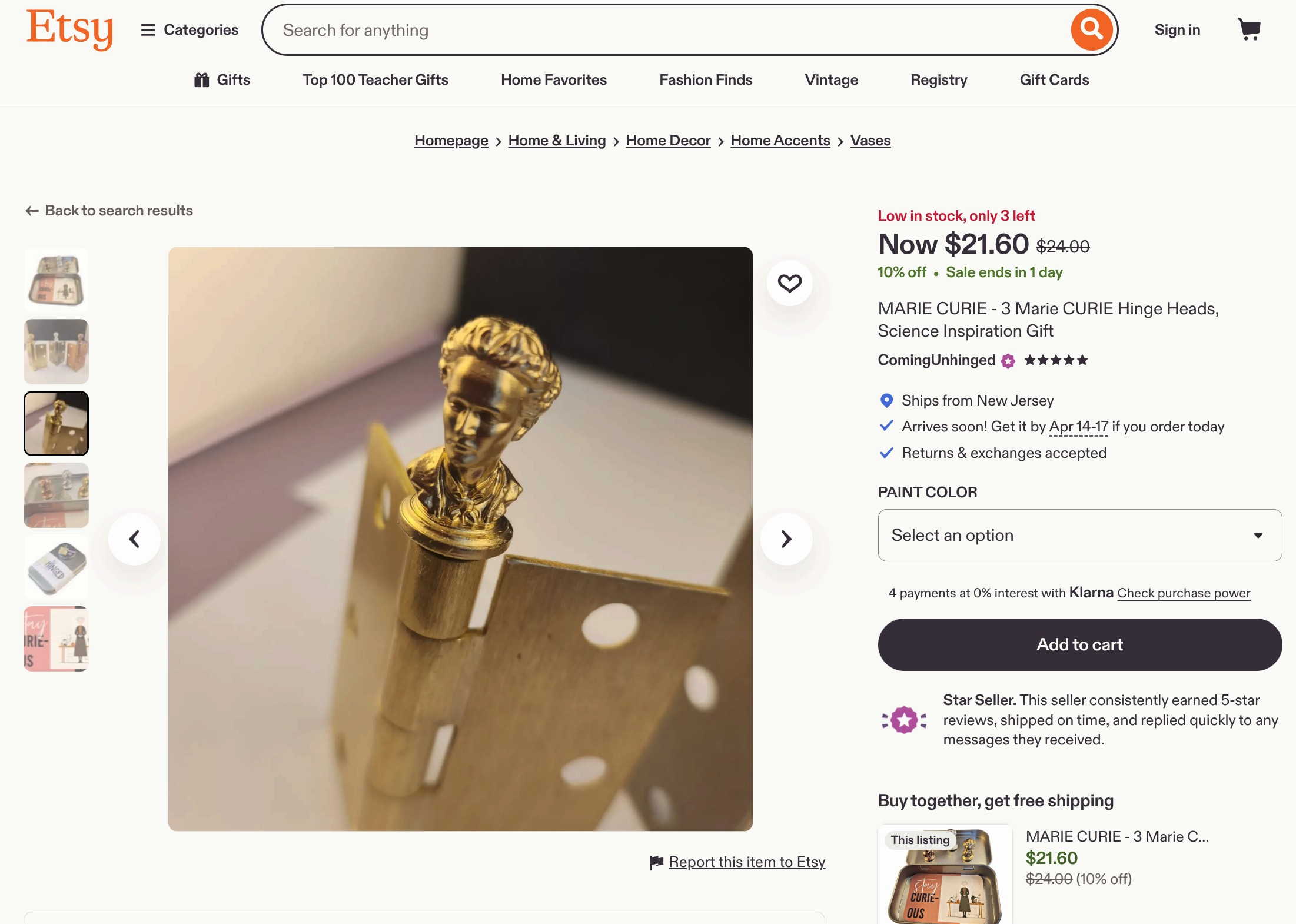
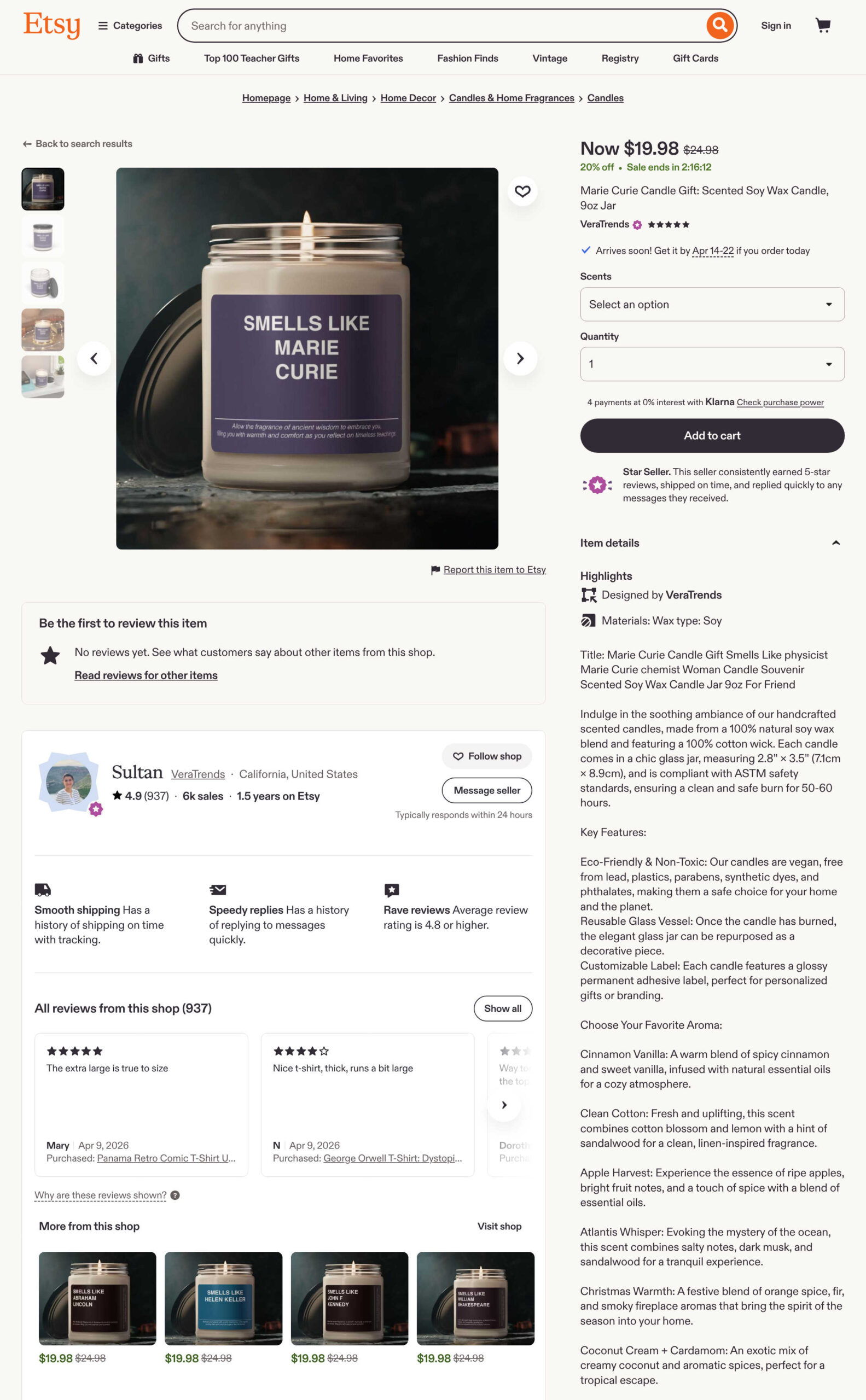
Further possibilities abound beyond coins and stamps. There are Christmas tree ornaments of Marie Curie,48 t-shirts with Marie sipping a cup of radioactive tea,49 tarot cards (in which she is The Magician),50 and door hinges embellished with her head in miniature,51 and soy wax candles that purport to *smell* like Marie Curie.52 53
Perhaps such knick-knacks are too frivolous for your staid and dignified stoicheiophilic display. We’re celebrating human ingenuity and the ever-expanding extent of knowledge, for gosh sakes! Fret not, friend. You, too, have many suitable options.
Any coleopterists in the audience might know about Psammodes sklodowskae, its latter half taken from Marie’s maiden name. About two centimeters long and dull brown, it’s a bit humble for the typical display case — but it would certainly be eye-catching among a collection of chemical elements. Especially if the specimen is not yet dead.
Mineralogy provides possibilities more congruous with the rest of our collections, like curite, sklodowskite, and cuprosklodowskite. None of them contain any curium, of course, *but!* they are all highly radioactive, so they win points for being on-theme.
The most ambitious stoicheiophiles might aspire to win one of the many scientific prizes named after one or more Curies. Please note, however, that the Irène Joliot-Curie Prize derives its name from an *entirely different* genius than element 96 does, so any winners seeking to fill their element collection have my condolences alongside my congratulations.54
A creative mind could surely find even better ways to represent curium, but there’s one more that I think deserves special mention: We could construct a simulacrum. Something that stands in for the real deal, to recreate what it might be like to display a lump of curium if we could.
Gadolinium would make a good base. It’s directly above today’s subject on the periodic table, so you know what that means: their similar electron arrangements make them behave alike, in a chemical sense. They also have comparable melting points, silvery color, and oxidation states. But there could be other possibilities: lanthanum is “isotypic” with curium, which means they form identical crystal structures under certain conditions. A large crystal of lanthanum could take the same shape as one of curium, were it possible to create such a thing.
Curium has some remarkable properties that a good facsimile will represent. Macroscopic amounts give off a faint purple glow. Accurately reproducing that glow is quite difficult, because it doesn’t come from the element itself, but the ionized air surrounding it. Curium is so intensely radioactive that its alpha particles tear the electrons off the surrounding air molecules, releasing light in the process.
It wouldn’t really be the same, but you could coat your base material in paint containing strontium aluminate doped with europium, which would cause your sample to glow purple in a dark room. Be careful, though! There are unscrupulous sellers who list powdered strontium aluminate for sale, but then actually send zinc sulfide, which is much cheaper and not as good!
Due to its extreme radioactivity, a sample of curium would be pretty darn hot to the touch. Exactly how to mimic this effect is left as an exercise for the listener. Just try not to re-introduce hazards to your health and home.
With a little care, you might create a pretty good representation of curium for your elemental exhibition. It would be artificial, yes, but remember: so, too, is curium itself.
Perhaps the biggest difference is that *this* one would belong entirely… to you.
Thanks for listening to The Episodic Table of Elements. Music is by Kai Engel. There are tons of show notes this week, including a whole passage about the RMS Olympic that I found fascinating but could not in good conscience include in the main episode. To read about that and much more, visit episodic table dot com slash c m.
Next time, we’ll encounter the first of a new class of elements: those named after laboratories.
Until then, this is T. R. Appleton, and I’m sorry I was gone, but look, I made you some Content!
Sources
- Chemistry Of Chemical Bonding, p. 325. R. K. Sharma, 2007.
- Handbook Of Materials Science: Volume 1 General Properties, p. 15. Edited by Charles T. Lynch, 2019.
- The New York Times, Firemen Strike; Olympic Held. April 25, 1912.
- Much of the information in this section taken from RMS Olympic: Titanic’s Sister, Mark Chirnside. Tempus, 2004.
- ibid., but also Arthur Lismer – Olympic With Returned Soldiers.
- At that time, the Olympic displaced 53,000 tons of water, while the U-103 came in at 800 pounds. A Civic is about 3,000 pounds, the soil about 50, which is a ratio that’s similar enough for podcasting.
- The “Olympic” Class Ships, “Wartime: ‘Old Reliable’. Mark Chirnside, 2011.
- Science Photo Library, Arthur Conan Doyle With Family Aboard Ocean Liner. Library of Congress.
- as in beer and as in speech, of course.
- , this page.
- Science and Society, p. 229. John Scales Avery, 2016.
- Historical Currency Converter
- France inflation calculator
- American Queenmaker: How Missy Meloney Brought Women Into Politics, Preface. Julie Des Jardins, 2020.
- The Delineator, The Greatest Woman In The World. Mrs. William Brown Meloney, April 1921, p. 15-17. I’ve also saved a copy of the article here for posterity.
- ibid.
- Mrs. William Brown Meloney’s Introduction to Pierre Curie, by Marie Curie. 1923.
- CPI Inflation Calculator.
- American Experience, Not All Women Gained The Vote in 1920. July 6, 2020.
-
- Madame Curie: A Biography, p. 332 – 333. Eve Curie, translated by Vincent Sheean, 1938.
- The New York Times, Mme. Curie Finds America A Marvel. June 25, 1921.
- U.S. Department Of Energy, Manhattan Project Background Information And Preservation Work. Last updated January 15, 2025.
- U.S. Bureau Of Labor Statistics, CPI Inflation Calculator.
- Big Science: Ernest Lawrence And The Invention That Launched The Military-Industrial Complex, Chapter 4: Shims And Sealing Wax and Chapter 8: John Lawrence’s Mice. Michael Hiltzik, 2015.
- Big Science: Ernest Lawrence And The Invention That Launched The Military-Industrial Complex, Chapter 21: The “Clean Bomb”. Michael Hiltzik, 2015.
- U.S. Patent 3,156,523, “Element 95 And Method Of Producing Said Element.” Glenn T. Seaborg, August 23, 1946.
- U.S. Patent 3,161,462, “Element 96 And Compositions Thereof.” Glenn T. Seaborg, February 7, 1947.
- The New York Times, Seaborg Is Upheld In Seeking To Patent Artificial Elements. March 25, 1964.
- Decisions Of Commissioner Of Patents And U.S. Courts In Patent And Trademark And Copyright Cases, p. 458. 1964.
- Application of Glenn T. Seaborg, 328 F.2d 996 (C.C.P.A. 1964). Justia U.S. Law, March 19, 1964.
- Journal of Glenn T. Seaborg, January 1, 1980 – June 30, 1980, p. 129.
- It was called Oppenheimer.
- The New York Times, Seaborg Is Upheld In Seeking To Patent Artificial Elements. March 25, 1964.
- Brooklyn Law Review, Is The Sky The Limit? Patent Implications Of Discoveries Made In Outer Space, p. 926. Volume 84, Issue 3, May 1, 2019.
- Studicata Law Case Briefs, Application Of Seaborg.
- The Nobel Prize, Marie And Pierre Curie And The Discovery Of Polonium And Radium. Nanny Fröman, December 1, 1996.
- The Manhattan Project: An Interactive History, Uranium Mining. U.S. Department Of Energy – Office Of History And Heritage Resources.
- The Manhattan Project: An Interactive History, Non-Technical Personnel.
- A Brief History Of U.S. Research Funding, Will Bunch. Brown Alumni Magazine, Fall 205.
- Allocating Federal Funds For Science And Technology, Supplement 1: The Evolution And Impact Of Federal Government Support For R&D In Broad Outline. National Academy Of Sciences, 1995.
- Big Science: Ernest Lawrence And The Invention That Launched The Military-Industrial Complex, 15. The Postwar Bonanza. Michael Hiltzik, 2015.
- The Politics Of Pure Science, p.132. Daniel S. Greenberg, 1999.
- Physics World, What Can Postage Stamps Tell Us About The History Of Nuclear Physics? Ian Briggs, October 27, 2023.
- Chemistry International vol. 33 no. 6, An IYC Philatelic Tribute To Marie Curie. Daniel Rabinovich, November – December 2011.
- European Central Bank, France.
- EUR-Lex, Council Regulation (EU) No 729/2014 of 24 June 2014 on denominations and technical specifications of euro coins intended for circulation (Recast)
- Etsy, Marie Curie Ornament. Forty-four dollars?!
- Etsy, Radiate Positivi-tea Marie Curie Shirt. And, what the heck, here’s a screenshot for posteri-tea.
- Kickstarter, The Women Who Changed The World–SHE Pioneers Tarot. They’re quite lovely and clever, really!
- Etsy, MARIE CURIE – 3 Marie Curie Hinge Heads, Science Inspiration Gift. The seller goes by the name — no joke — ComingUnhinged. Have a gander!
- Etsy, Marie Curie Candle Gift. Here’s a screenshot. I just can’t help myself, I don’t want anyone to miss out on all this Marie merch.
- I’ve been looking at these too long. I might actually want the door hinges now.
- Collège de France, Irène Joliot-Curie Prize.



I just wanted to tell you what a joy it was to find that you had published a new episode. Thank you very much for all your hard work!
It’s a privilege to get to hear that sentiment, truly. Thank you so much!
Oh my gosh SO GLAD YOURE STILL ACTIVE!!! Loved this pod for years. Xo 🇨🇦
I am, too! Now let’s see if I can pick up the pace a little bit! 🙃
Thanks very much for this new episode; as with your previous installments, I enjoyed it and learned from it. By way of gratitude, I’m planning to sprinkle “stoicheiophily” into my holiday party conversations. Let’s see if we can get that term into the OED!
Well, that would be a generous holiday gift from you to me! I hope you’re met with something better than a blank stare. 😄
I knew it was going to be a good day when I woke up to the notification of a new episode of The Episodic Table of Elements! I shall listen to this one in carefully measured stoichiometric amounts to make the joy last until the next episode (though it’s always worth the wait). Thanks for keeping this podcast alive for all the faithful listeners!